
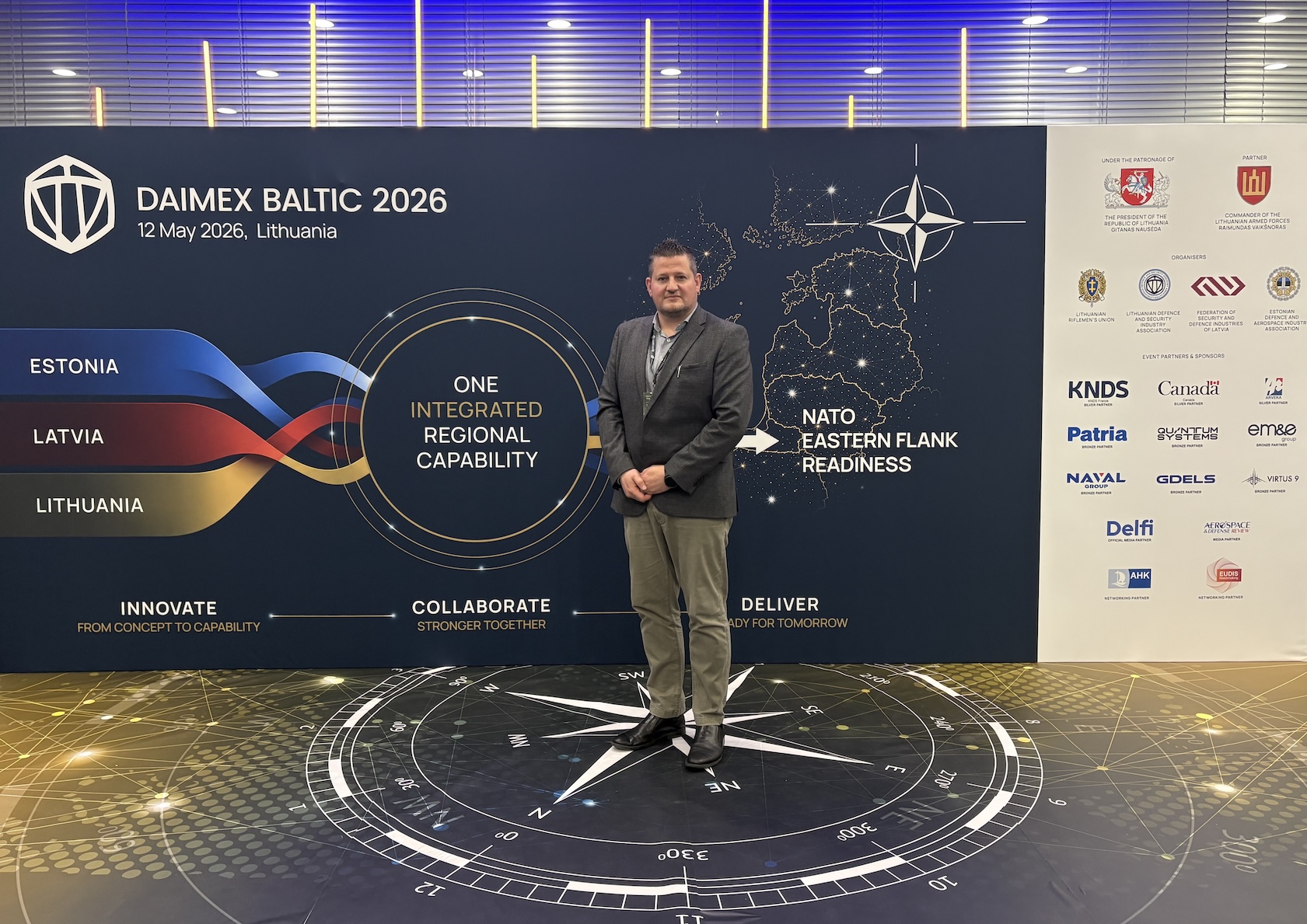
The following was written by Stephen Jackson, Business Development Manager - EMEA, and provides his insights from the opening remarks at the DAIMEX Baltic 2026 Conference.
~~~
One of the more important messages delivered at DAIMEX Baltic 2026 this morning did not focus on platforms, weapons systems, or procurement budgets. It focused on industry.
The opening remarks from the President of Lithuania carried a level of urgency and clarity that many Western defence discussions still struggle to fully embrace:
“There is no military readiness without industry readiness.”
That statement deserves serious reflection.
For decades, much of Europe treated defence manufacturing as something that could be optimized, outsourced, delayed, or scaled only when required. Recent events have exposed the weakness in that assumption. Industrial capability is not a switch that can simply be turned on during a crisis.
Trust cannot be improvised.
Partnerships cannot be improvised.
Production readiness cannot be improvised.
By the time a crisis starts, the real work should already have been done. The factory floor is now directly connected to the battlefield. What engineers design, what supply chains deliver, and what technicians manufacture has a direct impact on operational readiness, survivability, and deterrence.
This is why defence spending should not be viewed as a burden. It is the price paid for security, resilience, and strategic freedom.
Lithuania understands this particularly well.
There is a seriousness and urgency visible across the Baltic defence ecosystem that stands out. Decisions move faster. Collaboration between government and industry is more direct. Industrial participation is treated as a strategic requirement rather than an administrative exercise.
The emphasis is increasingly shifting toward scaling what already works. That matters.
In periods of elevated geopolitical tension, “perfect” solutions delivered too late often have less value than robust, proven, fit-for-purpose systems delivered on time and in meaningful volume. Mass still matters. Industrial depth still matters. Delivery still matters.
For industry, this creates both pressure and responsibility. As defence manufacturers and suppliers, we have an obligation to be robust, responsive, and dependable. Delivering “on time and in full” is no longer simply a contractual metric — it is part of national resilience.
At DEW Engineering and Development, this philosophy strongly aligns with how we approach defence manufacturing and international cooperation.
Whether supporting advanced composite armour systems, survivability solutions, specialized shelters and containerized systems, naval protection applications, or complex engineering and fabrication programs, the focus is increasingly the same across NATO and allied markets:
Innovate. Collaborate. Deliver.
Equally important is the industrial base behind those capabilities.
Through vertical integration with CoorsTek and its advanced ceramics capability in Europe, including Turnov in the Czech Republic, we see growing demand for resilient regional supply chains, localized manufacturing, and trusted industrial partnerships that can scale when required.
The conversation is no longer only about technology superiority. It is about:
Industrial resilience.
Supply chain survivability.
Production scalability.
Trusted partnerships.
And the ability to sustain capability under pressure.
The Baltic region understands this reality with remarkable clarity.
DAIMEX Baltic 2026 is proving to be more than an exhibition. It is a reminder that defence readiness is no longer defined only by armed forces, but by the strength, responsiveness, and seriousness of the industrial ecosystem standing behind them.
Because ultimately, military readiness begins long before the battlefield.
It begins on the factory floor.